

But you, beloved,
Building yourselves up on your most holy faith…
JUDE 20
Catholic Choppy Waters
As I tell you on the ORCatholics home page, since 2018 and the Summer of Shame for the Catholic Church, observing Catholics have realized that the scandal back then was only the tip of the iceberg with problems facing the faithful in today’s Church. One faithful Catholic on social media with good commentary, articles, and videos to help navigate our faith’s choppy waters is Anthony Stein, who has a work called Return to Tradition Org. Today’s video post is: Cardinal Muller Warns the Faithful.
Anthony Stein’s YouTube video shares an article from InfoCatolica, a Spanish Catholic magazine, featuring Cardinal Müller’s interview with a journalist. The article emphasizes our need to persevere in faith despite the current confusion. I visited InfoCatolica, found the article with Cardinal Muller, and used the “translate into English” tool to share the full article. ( It’s also a line to a great Catholic resource that can be translated into English.) You’ll find the link below.
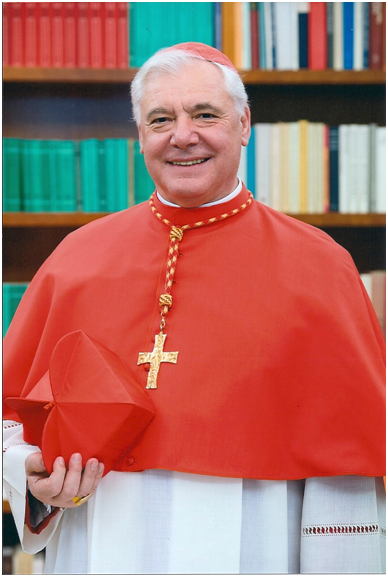
Cardinal Müller
Speaks
( InfoCatólica ) In an extensive interview given by Cardinal Gerhard Müller to Riccardo Cascioli, within the framework of the meetings of La Bussola Quotidiana , the prelate addresses fundamental themes that affect the Church today, placing special emphasis on the need to persevere in faith despite times of confusion.
Müller: «Anyone who does not see the current confusion is blind»
Müller, who has been prefect of the Congregation for the Doctrine of the Faith, expresses his concern about the doctrinal ambiguity that has taken hold in some sectors of the Church.
Referring to the Gospel of St. Matthew (24:11-13), which mentions the appearance of false prophets and the cooling of love, Müller notes: “This passage seems to accurately describe what we are experiencing today. We see confusion arising and many losing their fervor in their faith, but the Lord tells us clearly that whoever perseveres to the end will be saved.”
The Cardinal recalls that perseverance is not something that the faithful can achieve on their own, but is a gift from God: “We can do nothing without God’s grace. It is He who gives us the strength to go on, especially when trials and temptations overwhelm us.” In this sense, Müller stresses that perseverance is key to overcoming the disappointment and discouragement that can arise, both from one’s own difficulties and from the weaknesses of others within the Christian community.
Doctrinal confusion and ambiguities
During the interview, the Prefect Emeritus of Doctrine for the Faith addresses the growing doctrinal confusion within the Church, which he describes as a real threat to the unity of the faithful. He recalls the words of the late Cardinal Carlo Caffarra, who had already warned that “anyone who does not see the current confusion is blind.” Cardinal Müller criticizes the lack of clarity on some fundamental aspects of doctrine, pointing out that there are those who seem to want to build a Church “to suit their own desires,” which leads to a dangerous drift of faith.
In particular, he refers to the tensions that have arisen around the figure of the Pope and the contradictory interpretations of his magisterium. Müller indicates that, although the figure of the Pope is central to the Church, it should not be confused with the institution of the Papacy as a whole:
“It is essential to distinguish between the Papacy and the Pope as an individual. Popes are different people, with their own strengths and weaknesses, and they are not exempt from errors in their human decisions.”
The Cardinal explains that the Pope’s mission, as Christ entrusted it to Peter, is to “confirm the faithful in the faith,” but he assures that no Pope should act in a completely autonomous manner, but rather needs to have good advisors to help him discern the best decisions for the Church. In this regard, he underlines the importance of “balance” between the Pope and the College of Cardinals, as well as the value of ecclesiastical institutions, such as the Synod of Bishops, to guarantee that unity and fidelity to doctrine are maintained.
The role of the faithful and perseverance
As for the faithful who feel disoriented by the lack of doctrinal clarity, Müller encourages them to seek comfort and strength in the Word of God, in the tradition of the Church, and in the teaching of the great theologians and fathers of the Church:
«It is necessary to read and study the Bible, the Catechism, and the great documents of the Magisterium. It is also essential to turn to the work of renowned theologians such as St. Augustine, St. Thomas Aquinas and St. John Henry Newman.»
Müller also calls on the faithful to pray for their pastors, and to support bishops and priests who strive to be firm guides in the faith. He acknowledges that in the history of the Church there have been times when even the majority of bishops have not been up to the challenge, such as in times of the Arian heresy, but he assures that “the truth always prevails”:
«We have had some situations in the history of the Church when even the majority of bishops have not been good, as in the times of Arianism. Or, for example, here in Germany and England, during the Protestant Reformation, the bishops were not able to give a response or resist the new errors that arose within the Church. It would be very important to find bishops with great stature, who know the doctrine of the Church and who are not interested in speaking according to the taste of the majority.»
The mission of the Church is not a political project
The cardinal warns against the dangers of a merely horizontal approach to Christianity, which reduces faith to an effort to improve the world temporarily without taking into account the true purpose of Christian life: salvation. “Improving the world is a good thing, but it is not salvation,” says Müller. “Salvation is overcoming the distance that exists between God and us because of sin.”
In this regard, he criticizes the fact that some within the Church place more emphasis on social and political issues, such as climate change or migration than on the fundamental mission of the Church, which is to lead people to salvation. According to the Cardinal, these are issues that are primarily the responsibility of the State and politicians, while the primary mission of the Church is the eternal salvation of souls.
Jesus Christ, the only Savior
Müller also refers to religious relativism, which considers all religions to be equally valid for reaching God. “Jesus Christ is the only Saviour,” he insists. “Not all religions are equal, nor do they all lead to God. Only through Christ can we be saved, and this is not a claim made by men, but by God himself.” He asserts that although the Church recognizes that people of other religions can be saved, this does not mean that all beliefs are equal or true.
The Cardinal concludes by reaffirming the importance of evangelization and Christian witness in today’s world:
«Jesus gave his life for us, and we are called to do the same, to be witnesses of the truth that Christ is the only way that leads to eternal life.»
This interview is part of a series of weekly meetings organized by La Bussola Quotidiana , which aims to explore essential themes for the life of faith today. The central theme, “Persevering in faith,” will continue to be the subject of reflection in the upcoming meetings, which seek to offer clarity and guidance to the faithful in times of uncertainty.
This is the complete article on Cardinal Müller’s remarks for the faithful at InfoCatolica. To visit the page and see more articles on InfoCatolica, click: HERE. If it doesn’t appear in English, Google offers Google Translate there.
Thank you for stopping by ORCatholics.com! Please share this post with family and friends who might appreciate hearing what Cardinal Muller has to say. And let me know if you liked today’s resources!
May God bless you always,
Nancy Montgomery
© 2024 ORCatholics.com-ORCatholic.blog
 ORCatholics.com